Insurance and what the patient owes · 7 of 7
Your fee schedule, and what Mesio does not do
The ten-minute upload that improves every estimate at once, and a plain statement of where Mesio stops.
Every estimate is your fee minus what the carrier pays. Mesio can work hard on the second half and it is useless without the first, which has to come from you.
Getting it in
Upload it once. A PDF, a photo of a printout taped inside a cabinet door, or a spreadsheet. It becomes an editable table you can correct in place, so a bad scan of one line is a thirty-second fix rather than a reason to start over.
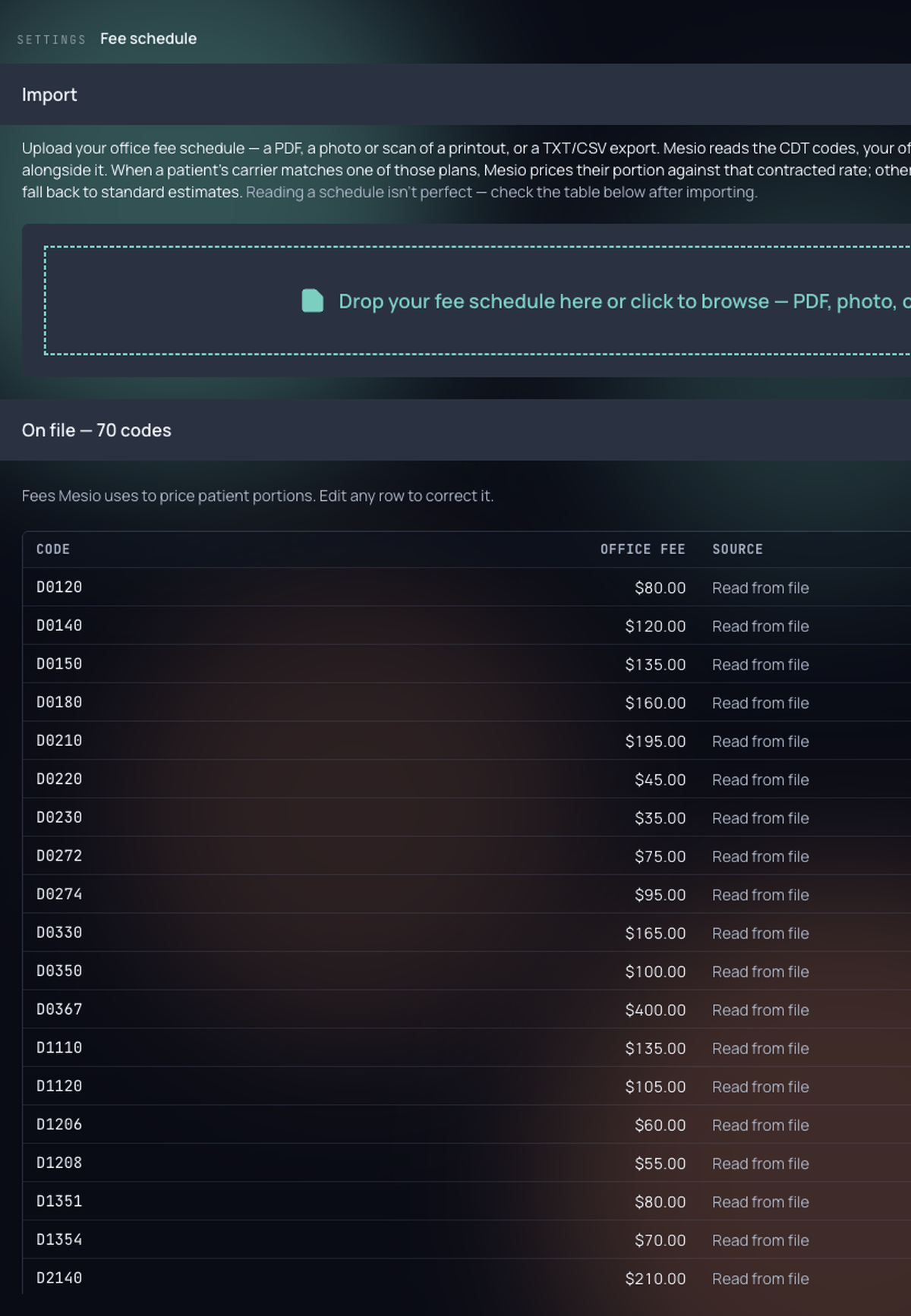
This is the highest-return ten minutes available in the product. It is not one estimate that improves, it is every estimate from then on.
Your fee and a contracted rate are different numbers
Worth separating, because they behave differently and people load one expecting the other.
Your fee is what you charge. It is what goes on the claim, and out of network it is what the patient is billed against.
A contracted rate is what a specific plan has agreed to allow you for that procedure. If you load those alongside your fees, in-network estimates stop being estimates: the contracted rate is the allowed amount, so the arithmetic is exact rather than inferred.
A code your schedule does not list stays blank
Mesio holds fees for a set of very common procedures so a new practice is not looking at an empty screen on day one. Beyond those, a code your schedule does not cover produces no fee rather than a guessed one.
That is deliberate and it is worth defending. The obvious shortcut is to price an unlisted code from a similar one, or to scale it off a market average. Both produce a confident number with nothing behind it, and an estimate gets repeated to a patient. A blank tells you something true. An invented fee does not.
If you see blanks, that is the fee schedule talking. It usually means the upload covered your common work and stopped. Adding the missing codes fills them.
What Mesio does not do
Everything above is about the estimate before the work. Being clear about where that ends:
- Mesio does not file claims. It estimates beforehand, writes the narrative, names the attachments a claim will need, and reads back what was paid. The claim itself goes out of your practice system, exactly the way it does today.
- Mesio does not submit anything to a payer on your behalf beyond asking what a plan covers.
- Mesio does not save into your practice system. On every route, it fills the fields and stops. A person reviews and commits. That boundary does not move, and it is the same boundary whether Mesio reached your system through an integration or by typing into it.
- Mesio does not adjust your fees. It reads what carriers allow. It never edits what you charge.
The short version: Mesio does the arithmetic and the paperwork around a claim. Sending it, and standing behind it, stays with the practice.
A PDF, a photo of a printout, or a spreadsheet. It becomes an editable table.