Perio by voice · 1 of 9
How voice perio actually works
Mesio does not interpret your sentences. It follows the chart, knows where your probe is, and would rather stop than write down a number it is unsure of.
Dictating a perio chart is not like dictating a note. A note can be reworded. A chart is a sequence of bare numbers whose meaning depends entirely on where the probe was when you said them. “Three, two, three” means nothing until you know it was the buccal of tooth 14.
So Mesio does not treat perio dictation as speech to be interpreted. It treats it as a chart being filled in, and it always knows which cell it is standing on.
The cursor is the point
Mesio keeps a cursor: a tooth, a surface, and which way you are traveling. You anchor it once — starting on 2 buccal — and from then on it walks the arch with you. Three numbers land on a tooth and it steps to the next one, skipping anything you marked missing.
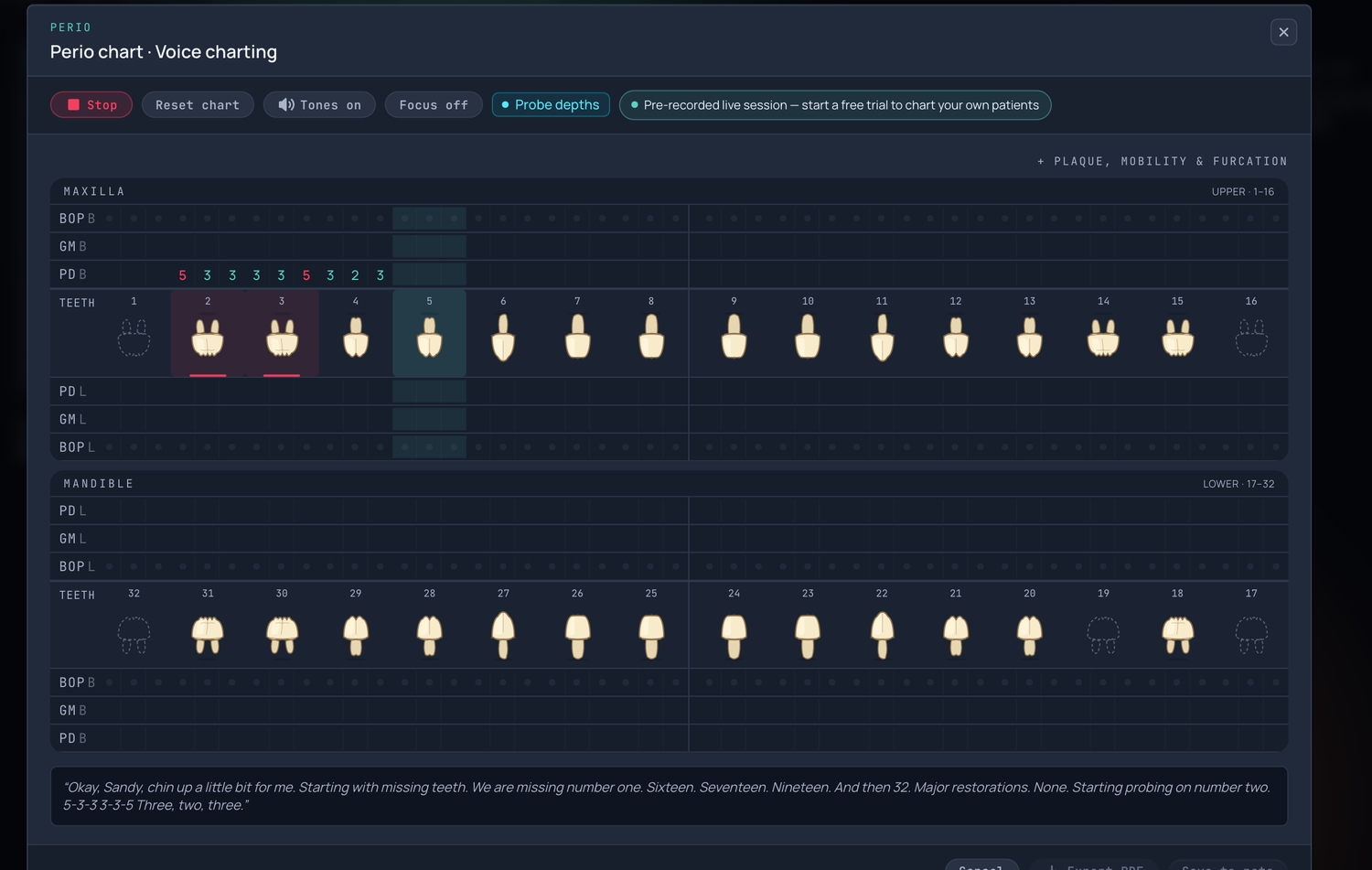
It knows the shape of a mouth. Charts draw the mouth as you face it, so the column order flips at the midline: traveling along the arch you meet the distal first on one side and the mesial first on the other. Mesio flips with you, which is why you never reverse anything and never say the site names out loud during a sweep.
At the end of an arch it wraps to the other surface by itself, and at the end of that it crosses to the next arch. You can still say wrapping around. It simply agrees with you.
Numbers get checked twice
Numbers are the hardest thing for any voice system to get right and the most expensive to get wrong. A misheard word in a note reads oddly. A misheard depth is a clinical record.
So no number reaches your chart on a single reading. Every one is cross-checked first. When the checks agree you never notice, which is almost always. When they do not, Mesio does not settle on a best guess. It pauses and tells you.
It stops rather than guess
The most important behavior is what Mesio does when it is unsure. A tooth needs three depths. If it hears two, or four, or a word where a number belonged, it does not put a value somewhere plausible. It holds the cursor, tells you which tooth it is stuck on, and waits for you to name a tooth.
This feels strict for about a day, and then you understand it. A guessed value is indistinguishable from a measured one once it is in the chart. A pause is not.
You can change how strict it is. In Settings → Voice charting, “When Mesio isn't sure” lets it halt and ask you to repeat, or flag the surface for an assistant and keep going. The right answer depends on whether someone is listening.
Every value keeps its receipt
A number in the chart is never just a number. It remembers the words that produced it, and — when your practice keeps session audio — the moment you said it.
That is what makes everything else possible. You can compare Mesio's chart against the one your assistant typed and settle a difference by listening to yourself say it. Without that history, a perio chart is a grid of numbers nobody can check, which is exactly the thing a practice should not accept from software.
A recorded session replays into a real chart before you read one yourself.